High-order functions
Gradgen supports high-order functions such as map, zip, and reduce.
Map
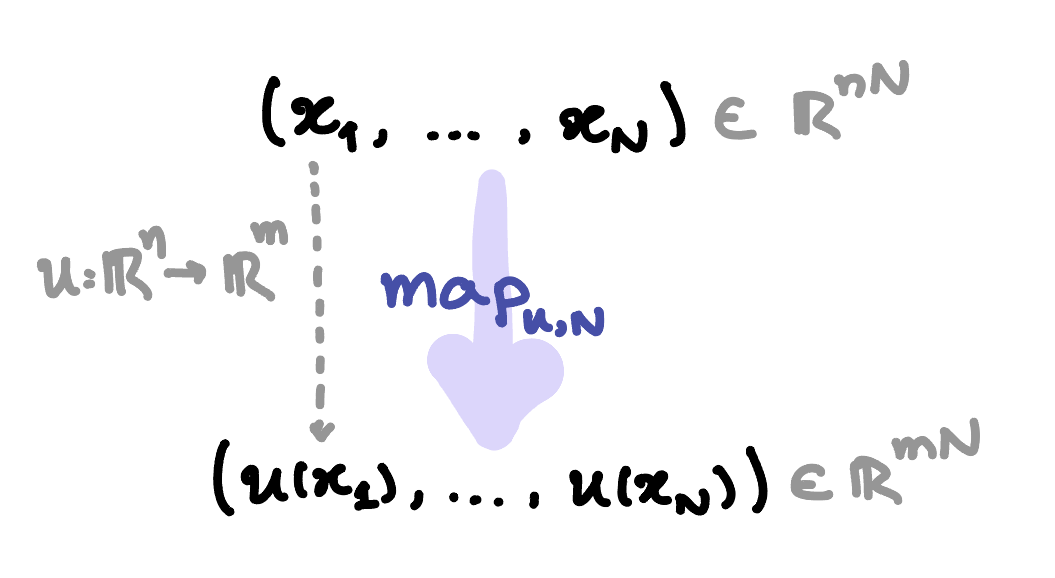
For an integer $N$, the map function consumes one packed sequence
$$\mathbf{x} = (x^{(1)}, x^{(2)}, \dots, x^{(N)}),$$
and returns the outputs
$$\mathbf{y} = (u(x^{(1)}), u(x^{(2)}), \dots, u(x^{(N)})),$$
i.e., it applies $u$ to each of the vectors of the sequence. In other words, it is the mapping $\mathrm{map}_{u, N}: \mathbf{x} \mapsto \mathbf{y}$. This operation is illustrated in the figure below.
Zip
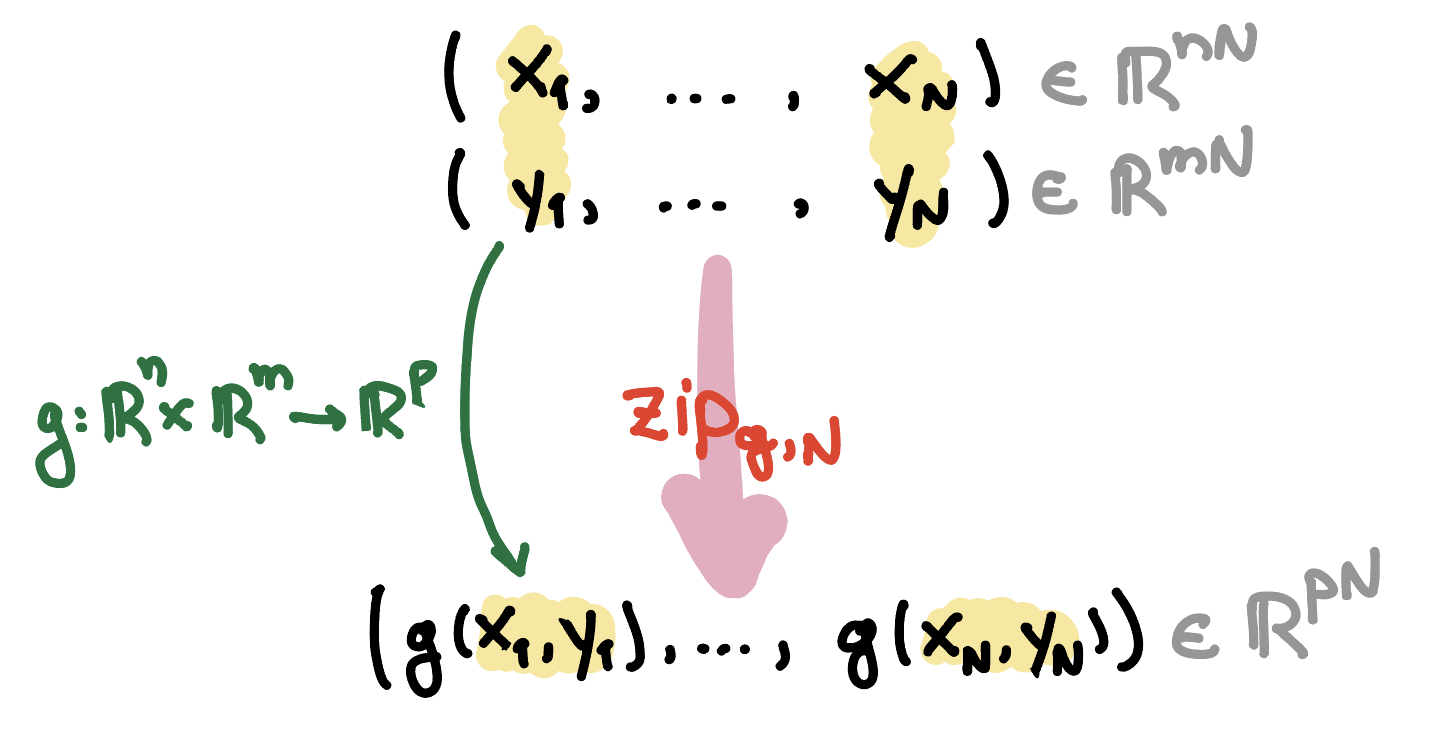
Similarly, for an integer $M$, the zip function consumes two packed sequences
$$\mathbf{a} = (a^{(1)}, \dots, a^{(M)}), \qquad c_{\mathrm{seq}} = (c^{(1)}, \dots, c^{(M)}),$$
and returns
$$\mathbf{z} = (g(a^{(1)}, c^{(1)}), \dots, g(a^{(M)}, c^{(M)})).$$
In other words, it is the mapping $\mathrm{zip}_{b, M}: \mathbf{a} \mapsto \mathbf{b}.$ The zip operation is illustrated in the figure below.
Reduce
See the demos.